
Last updated — September 28, 2026
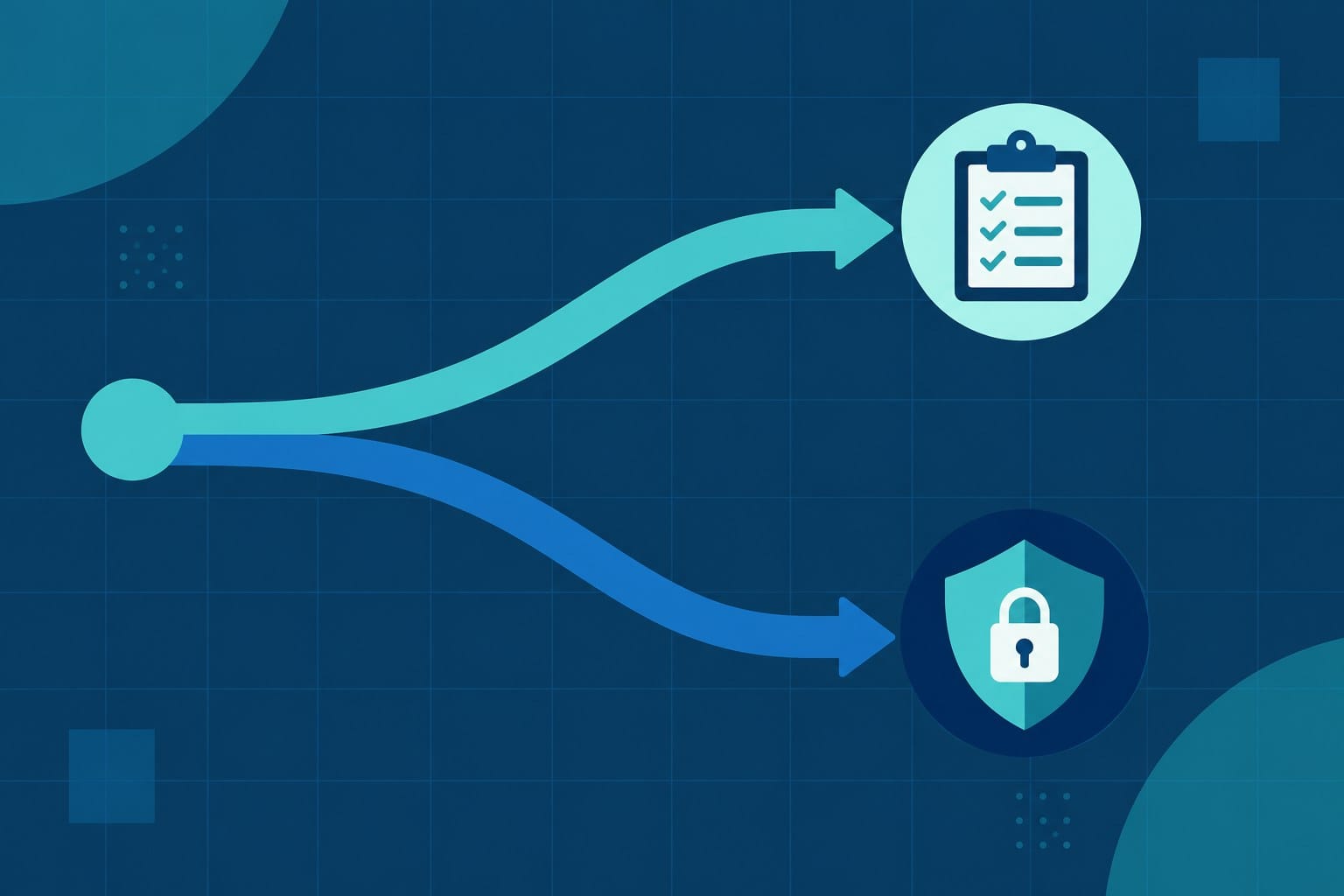
You’re not choosing between “technical” and “not technical”
If you’re on a helpdesk or in IT support right now, you’ve probably had this thought: the real money in tech is in cybersecurity, and cybersecurity means a computer science degree, certifications you don’t have yet, and years of hands-on network experience you’re not getting from a ticket queue. So you assume you’re stuck. Either you go back to school, or you stay exactly where you are.
That assumption skips over a third option that fits your background better than either of the first two: IT audit.
What cybersecurity actually asks of you
Cybersecurity, especially the engineering and analyst side of it, is a hands-on technical discipline. You’re configuring firewalls, analyzing malware, hardening systems, and responding to live incidents. It’s valuable work, but it’s also work that typically expects you to already know how networks, operating systems, and security tooling function at a deep level. Getting there from a helpdesk seat usually means years of lateral moves, a pile of certifications, and often a degree. None of that is a criticism of the field. It’s just an honest description of the on-ramp.
What IT audit actually asks of you
IT audit is a different kind of work entirely. An IT auditor isn’t configuring the firewall. An IT auditor is checking whether the firewall rules were approved by the right person, whether that approval is documented, and whether the control is actually operating the way the organization says it is. The job is built on structured thinking, clear documentation, and the ability to ask precise questions and follow the answer to evidence. It’s closer to the muscle you already use every day on a helpdesk when you diagnose a problem by asking the right questions in the right order.
There’s no coding requirement in IT audit. You don’t need a computer science degree to start. IT Audit MasterClass builds the curriculum from the fundamentals up, covering what a network is, how a database is structured, and what cloud infrastructure actually means operationally, before it ever asks you to apply that knowledge to a control test. Your helpdesk experience isn’t a blank slate here. You already know what a ticket queue full of access requests looks like, you already understand change management from the inside, and you already know how systems fail in practice rather than in theory. That’s a running start most career changers don’t have.
The senior track question
The real objection underneath “am I stuck in support forever” isn’t about cybersecurity specifically. It’s about whether there’s a path out of the queue and into something senior, strategic, and better paid, without first acquiring a credential you don’t currently have and can’t get quickly. IT audit is that path. It’s a role that reports findings to management, works directly with control owners across departments, and carries weight in a way that ticket resolution counts don’t.
On pay, the numbers are public and consistent. ZipRecruiter’s 2026 data puts the average IT audit salary at $93,000, with a typical range of $72,000 to $112,000. That range reflects where most working IT auditors sit, not an outlier best case.
Where AI fits into this decision
If you’re also weighing how AI affects either path, the honest answer is that AI is changing both fields, but audit is one of the professions built to govern AI rather than get replaced by it. A 2026 Gartner survey found that 93% of audit teams already use AI in some form, and 60% use it specifically to help draft audit reports. ISACA, the profession’s main credentialing body, launched an Advanced in AI Audit (AAIA) credential in 2025 because auditing AI systems is now its own specialty area. Whichever path you pick, you’re going to be using AI as a tool. In audit, you’re also increasingly the one reviewing how other departments use it.
How to actually tell which one fits you
Ask yourself what part of your helpdesk job you’re actually good at and don’t mind doing more of. If it’s the deep technical troubleshooting, the packet-level problem solving, the part where you’re happiest elbow-deep in a system, cybersecurity engineering is worth the longer runway it requires. If it’s the part where you’re documenting what happened, following a process to its source, and explaining clearly to someone else why something is or isn’t working the way it should, that’s the instinct IT audit is built around.
Why this needs structure, not a self-paced video course
Whichever path you choose, don’t try to make the jump alone with a stack of bookmarked tutorials. IT Audit MasterClass runs as a live, remote, cohort-based program specifically because career changers who study solo tend to stall out at the first genuinely confusing concept, with no one to ask and no deadline pushing them forward. A live cohort keeps you moving with real-time instruction, peers making the same pivot, and a schedule that doesn’t let the material quietly slide for a month.
If the helpdesk queue is starting to feel like a dead end and cybersecurity feels like it requires a degree you don’t have, IT audit is worth a serious look. It doesn’t require the credential you think you’re missing. It rewards the diagnostic instincts you’ve already been building.
IT Audit MasterClass
Six live evenings. Interview ready in three weeks.
Live IT audit training for career changers, on Google Meet with a real instructor. $1,500, with payment plans.